Author: Lucas Pasa Mondelo

  • Albumza Case Study: Sweepstakes in California?

    Albumza Case Study: Sweepstakes in California?

    Last updated: November 12th 2026

    The world of sweepstakes is a rich source of cases to study. Legal opinions that allow operators to go live in the rich American market can generate substantial profits.

    And also a lot of legal problems!

    America certainly is extremely unique in terms of how legal intricacies work. Foreign companies and executives trying their luck in America must be very attentive to how things work. I’m not just talking about the “lawyer up” culture, which extends to how easily AGs and state AGs might sue non-compliant companies.

    Everything needs to be well-documented, not to mention the rigor of tax law. Even if an operator finds a legal loophole to operate in a gray American market, poor attention to bookkeeping and how salaries are paid to employees based in America can also generate a lot of issues.

    And how about “highly original” legal opinions? Albumza surely tried a new way of doing business.

    How Albumza Justifies Their Activities in California as a Sweepstakes Casino

    Essentially, the operator claims to be a platform that sells digital collectibles. All the sweepstakes casino-like products are technically a secondary consequence of said “e-commerce” activity.

    It’s very interesting to notice how some affiliates claimed up until recently that Albumza was the only active sweepstakes operator in California and New York, but the operator itself calls it anything but.

    That is, Albumza itself explicitly denies being a sweeps casino on its About Us page, in contrast with enthusiastic marketing on affiliate marketing websites saying that Albumza Casino is something like the “last frontier” of sweeps in California, for example.

    Post Update: November 12th, 2026

    Since the original publishing date of this post on October 4th, 2026, Albumza has been blocked to IPs in New York, but remains available for clients based in California, which perfectly illustrates how things change very fast for sweepstakes casinos in America.

    Mature real-money markets also come with strict regulations for affiliates themselves. When brand-new products operate within legal loopholes like sweepstakes casinos, the entire marketing activity supporting said products is also a new task for attorneys general: is the promotion of this product compliant with general marketing laws?

    For now, Albumza is live with a very particular business model focused on low tickets, a lot of friction, extremely limited email CS, and affiliates claiming things that, in my opinion, are very dangerous to the operator itself.

    More to follow on the subject!
  • Midterm Results And The Consequences for Sweepstakes Casinos

    Midterm Results And The Consequences for Sweepstakes Casinos

    The Democratic Party now has the majority in the Senate as well as the House of Representatives. However, sweepstakes casinos are subject to regulations at the State level in America. Unlike other places in the world, conservatives and liberals haven’t historically defended or opposed gambling clearly.

    Naturally, conservatives who dislike gambling and condemn it on moral grounds are historically much more aligned with the Republicans; however, the party also has politicians who represent a part of American society pro-free enterprise.

    Moreover, neither the Republicans nor the Democrats champion or go against the agenda of federalism in a cohesive way: usually, when a party has a lot of power in Washington, they tend to try to capitalize on that fact and champion the powers of the central government in D.C.; on the other hand, when this power is not in its hands, they champion more power for the American States.

    State Jurisdiction: The Key to Understanding the Regulatory Sweepstakes Casinos during late 2026 and early 2027

    The United States is a lot more complex than European countries in general when it comes to legislation.

    The last time the gambling industry saw a federal-level situation that impacted the industry across all of America was in 2018. On that occasion, the U.S. Supreme Court ruled that sports betting was not unconstitutional, on the grounds of the 10th Amendment of the U.S. Constitution.

    While the ruling didn’t expressly allow sports betting, it gave back the power to the American States to decide what to do.

    Right now, Sweepstakes Casinos are not being discussed in those terms. It’s fair to say that Prediction Markets are making a lot more noise than sweepstakes casinos, and the chances of a federal ruling regarding prediction markets within the U.S. Supreme Court or through other legislative paths seem a lot more likely than a movement to discuss sweepstakes. 

    That seems to be explained by two distinct reasons: the aggressive go-to-market of prediction markets compared to sweepstakes casinos, and the fact that the products offered by prediction markets overlap a lot with several traditional financial market products 

    What to Expect for Sweepstakes Casinos During Q4 2026 and Q1 2027

    This is a very complex moment for American Politics. A big reshaping of the political landscape just happened, and there are numerous topics being discussed for 2027.

    Gambling and sweepstakes casinos are just one more topic that will be discussed.

    It’s crucial to understand that America has lived through extremely turbulent years recently, with new wars, a crackdown on immigration, among other things.

    This is not criticism of the Administration of Donald Trump. What I mean is that both the Republicans and the Democrats are digesting the results of the elections, and our industry is just one industry trying to understand what’s next for them in America.

    For us in the sweepstakes casinos world, it’s time to analyze each American state and understand which states will see new governors, as well as the general political landscape of each state, and analyze every breaking news story to figure out what will actually happen in each American jurisdiction in the coming months.

    Stay tuned for more analysis like this in the aftermath of the 2026 Midterm elections in America!

  • Why Evolution And Stake Were Targeted By American Authorities

    Why Evolution And Stake Were Targeted By American Authorities

    Lawsuits, especially in America, are all about money. The authorities would not go after dodgy GSPs located overseas when they can target large companies with a clear legal presence globally. 

    America has a very peculiar judicial system, which some countries consider an inspiration. Other countries, however, have their reservations about the American culture in this sense.

    To “lawyer up” is a phrasal verb that describes this side of American culture very well. American lawyers are extremely commercially savvy, capable of negotiating the end of a lawsuit minutes before actually going to court, or during a trial.

    That tendency, however, definitely isn’t confined to the private sector. 

    Understanding the American Legal System and How It Affects Gambling Operators

    By stepping into the shoes of a local authority like a state attorney general or a federal judge, it becomes easier to understand why big names in the global gaming industry like Stake and Evolution were targeted in their famous respective lawsuits.

    For starters, it’s crucial to understand that lawsuits like that are not necessarily personal. I am not accusing any American authority of malpractice. In fact, what I am describing here as the Editor-in-chief of a B2B industry portal is exactly the opposite.

    Legal authorities spotted a new product that describes itself as “a gray market product”. Legal opinions, signed by prestigious lawyers, are backing their commercial presence in America. But if the authorities don’t agree with those legal opinions, how and when can they make themselves heard?

    Leading industry suppliers like Evolution and leading operators like Stake have clear legal representation, unlike many GSPs and operators present in America. Some operators don’t even have an American incorporated company. 

    Therefore, by questioning the commercial activity of large operators and suppliers with a clear legal incorporation and legal team in America, the industry hears the message, and things eventually change. 

    Of course, legal action, trials, and disputes aren’t the only ways that jurisdictions can change, whether in America or globally. 

    Legislative Houses’ Work VS Legal Action: Different Regulatory Challenges

    Legislative houses at the State Level and Federal Level in America can change the regulatory landscape, but when it comes to gray areas, it’s very common to see legal action happening before formal discussions eventually happen at the legislative level, which can ultimately lead to new laws: in our industry, this means the creation of a regulated market (white), with clear taxes and licenses, or the banning of a specific vertical like online sports betting or online casinos, for example. 

    The big discussion around sweepstakes casinos is whether they are a gambling product or not, which would overlap with the grounds of specific legislation regarding real-money gambling.

    And, as America is a country full of numerous internal jurisdictions, each American state is a different reality. 

  • Midterm Elections in America

    Midterm Elections in America

    Consequences for Sweepstakes Casinos, Prediction Markets and iGaming: Sweep Times Coverage

    Midterm elections are always very important. But this time, they’re extremely historic.

    Donald Trump has made history in his first 2 years of his second term in numerous ways. Regardless of whether someone considers those changes positive or negative, the radical change in foreign military and economic policies has completely marked American history as well as international diplomacy, in a radical swing that is perhaps unparalleled in modern American history.

    America and The Gambling Jurisdictions: State By State Laws

    America regulates sweepstakes casinos and other forms of gambling, including real-money gambling and prediction markets, at the State level. This means that the ongoing midterm elections are particularly important for the sweepstakes casinos industry, as well as other verticals of our industry.

    Understanding the peculiarities of each American Jurisdiction is key to understanding the regulatory future of the sweepstakes casinos industry.

    Here at our news section, we’ll analyze every confirmed result of the 2026 American midterm elections and the potential consequences for the gambling industry, within and beyond the sweepstakes casino environment, including Prediction Markets and Real Money iGaming.

    Stay tuned for our updates in the coming days as formal results are confirmed at the State Level, as well as the consequences for America at the congressional and Senate levels.

  • Why Famous Real-Money iGaming GSPs Left the American Sweeps Market

    Why Famous Real-Money iGaming GSPs Left the American Sweeps Market

    Some GSPs, including Pragmatic Play, decided to leave the vertical in America. Potential legal liabilities and litigation costs were major factors behind this decision.

    Sometimes, the cost of some opportunities in terms of risk isn’t worth it. That’s what Pragmatic Play decided when leaving the vertical in America.

    Back when the decision happened in 2025, America was seeing major volatility in the regulatory landscape for sweepstakes operations.

    Eventually, after the big markets of California and New York shut down, some states remained fair game.

    However, large operations need to take extra care. Lawsuits are about money, and state-level prosecutors don’t go after GSPs that don’t have the deep pockets to eventually pay for potential penalties and other forms of financial liabilities derived from courts. 

    The Names That Attract Legal Problems

    Lawsuits, especially in America, are also influenced by media and politics. It’s not uncommon for prosecutors and judges to eventually run for seats in Congress or state legislatures. 

    So not only do they tend to go after big names, but also the companies that can eventually pay for whatever wrongdoing is claimed in a lawsuit. 

    Suing Stake, Evolution, or Pragmatic Play companies and their peers in terms of size can be effective, while going to court against smaller operators (especially those incorporated offshore), or small studios from foreign jurisdictions is below the radar, as government authorities might win in court, but never see a penny.

    Moreover, if the names aren’t easily recognized by the press, those lawsuits draw less attention.

    Scrutiny over GSPs and operators isn’t uniformly spread across the industry, just like it happens in any industry or economic activity. 

    So risk management at the shareholder and decision-maker level needs to be mindful of the size of a company, whether it is a listed company, and what the legal risks are according to how their brands are perceived in America and globally.

  • Why Gift Card Redemptions Exist on American Sweepstakes Casinos

    Why Gift Card Redemptions Exist on American Sweepstakes Casinos

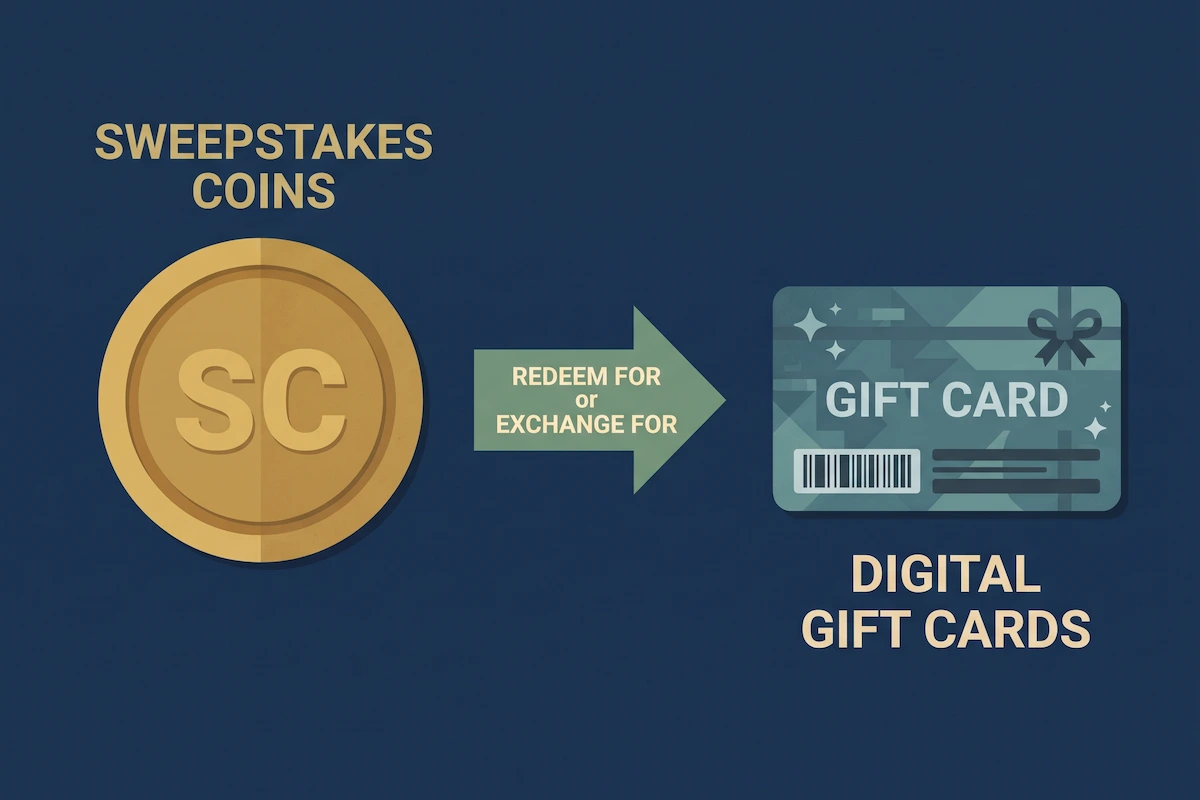
    Sweepstakes Casinos aren’t real-money operators, and in some cases they can only reward players with gift cards, or prefer to do so rather than process fiat currency redemptions.

    Gift cards are legally more complex as a form of redemption at a sweepstakes casino than, for example, an ACH money withdrawal.

    The same applies to other forms of alternative redemption, such as collectibles like TCG cards, which is a growing trend in some jurisdictions such as New York State.

    Sweepstakes Casino trade-offs: Is it Better for the Casino to Process Gift Card Redemptions?

    The short answer is potentially, yes. Gift cards are usually offered through partnerships with companies that distribute them. Distributing gift cards tied to a specific retailer is a strong marketing tool, and these companies partner with retailers.

    Moreover, a retailer expects someone with a gift card to spend more than just the card’s value.

    That said, a sweepstakes casino doesn’t necessarily need to purchase gift cards at face value.

    Of course, running a well-oiled platform that efficiently redeems the gift cards is another story.

    However, processing fiat currency withdrawals comes at a cost (after converting alternative currencies (tokens) like fun coin and sweep coin). Payment Service Providers in the sweepstakes environment can represent a big expense for operators.

    I’ve seen firsthand a newborn platform (not an operator, a supplier) have to pay a minimum daily volume to keep a new contract running with a PSP.

    To avoid contract termination due to low processed volume, the directors had to use their personal credit cards to pass money through the PSP gateway before the newborn company had its bank accounts sorted and an actual financial flow in place. 

    And even when everything is up and running with PSPs, it’s crucial to have more than one PSP, and backup options can come at a salty price in terms of commissions and minimum volume.

    If a sweepstakes operator isn’t incorporated in America, PSP integration becomes exponentially more complicated. 

    Gift Cards and Alternative Forms of Redemption: Not a Necessity in Europe and Real-Money Operations 

    Gift card redemptions generate numerous complications for a casino operation. Instead of just focusing on running a smooth financial operation, including choosing good PSPs, monitoring fraud attempts, and complying with Anti-money laundering regulations, the IT implications of integrating gift card partners add new layers of complexity to the operator’s front end and back-office database, not to mention front-end UX/UI and even back-office UX/UI.

    In iGaming real-money operations, that friction and headache simply don’t need to exist. When a casino can stick to the usual business model of receiving deposits and processing withdrawals, operations are far more streamlined compared to the world of sweepstakes casinos.

  • Why U.S. Dollars Can’t Be Mentioned In U.S. Sweepstakes Casinos

    Why U.S. Dollars Can’t Be Mentioned In U.S. Sweepstakes Casinos

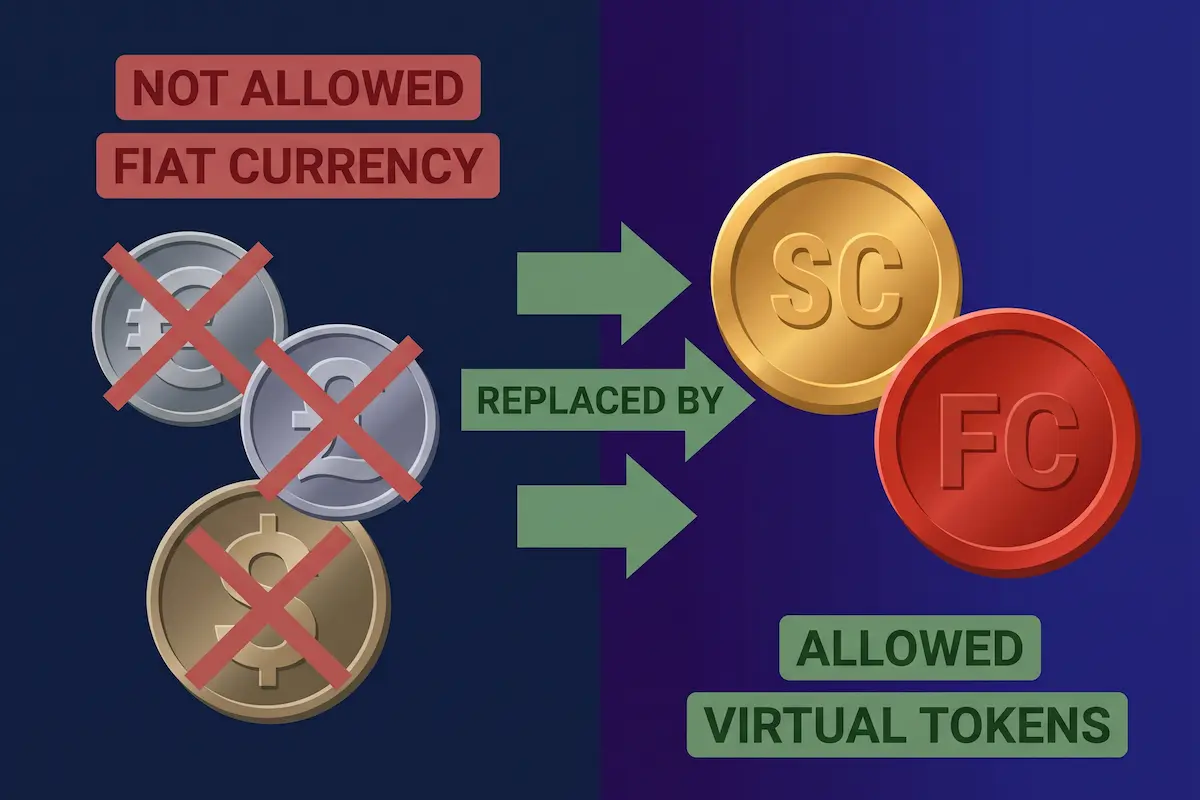
    U.S. Sweepstakes Casinos are gray-market operations that don’t work like fully licensed, real-money iGaming operations. The legal loophole that lets them remain active requires suppressing any mention of U.S. Dollars (USD) or other fiat currencies like Euros, Pounds Sterling, and others. 

    Any mentions, including symbols like €, £, and of course, $, can become problematic.

    How American Sweepstakes Casinos Operate Legally

    Essentially, American sweepstakes casinos operate lawfully by complying with other legislation and regulations, including sweepstakes for retail operations and e-commerce.

    The full reasoning behind why they can operate without a real-money gaming license is far more intricate, but this is one of the most surprising things for European real-money iGaming operators when they start familiarizing themselves with the American sweepstakes environment.

    Even Euros and Pounds Can Generate Compliance Problems in America 

    Sweepstakes operators in America try their luck within a very narrow, well-defined gray area of state-level American law.

    That bold interpretation of laws and regulations by operators and their lawyers, often in the form of legal opinions, is frequently frowned upon by state attorneys general and local law enforcement.

    Government authorities aren’t always interested in working hard to find ways of interpreting laws in the most favorable terms possible for the private sector, especially when it comes to casino-like products like a sweepstakes casino slot game or roulette live room.

    That said, if an American sweepstakes operator has a supplier of games that converts, for example, slots that are native real money gaming titles, and a faulty game displays a balance in fiat currency instead of Sweep Coins or Fun Coins (the usual alternative internal tokens/currencies used by the sweeps industry), the end result is that the operator can be penalized on the grounds of compliance.

    Even if an operator tries to argue that the studio is foreign, in case of a proven faulty display of GBP or EUR on an American sweeps casino player screen, depending on the mood of the prosecutor or AG bringing up the subject in court, the possibility of legal and financial liability remains a reality for the casino.

    The Alternative Coin System: Fun Coin and Sweep Coin

    The solution for sweepstakes casinos is to adopt a system of virtual internal tokens that are not legal tender, like USD, EUR, or GBP.

    The reason for having more than one token also relates to the legal opinions that support these operations, but they’re tied to AMOE, another intricate concept behind why sweepstakes casinos can do business in some American states.

  • Faulty Game Exploitation: What It Looks Like in the Back Office of a Sweeps Operator

    Faulty Game Exploitation: What It Looks Like in the Back Office of a Sweeps Operator

    Fraudsters target games that seem faulty, and they know what they’re looking for. 

    Fraudsters in the online gambling world can be very tech-savvy. So much so that I’ve seen firsthand cases of exploitation of brand-new, proprietary games from platforms that didn’t have any marketing campaigns yet.

    The back office is the heart of any casino, and sweepstakes operations are no different.

    However, reading data and interpreting it can be complex for an executive with only real-money iGaming experience.

    The alternative coin system causes players to bet differently depending on the type of currency involved, redeemable and not redeemable as cash.

    Moreover, platforms must work perfectly to filter data correctly.

    Game proficiency is also very important: financial fraud detection teams must understand the difference between an obscure, brand-new proprietary slot game and a market leader.

    Exploitations of very famous games created by market-leading studios hardly ever cause problems, and when they do, the GSP usually gets in touch before the operator detects the problem.

    How to Spot a Fraud and A Faulty Game

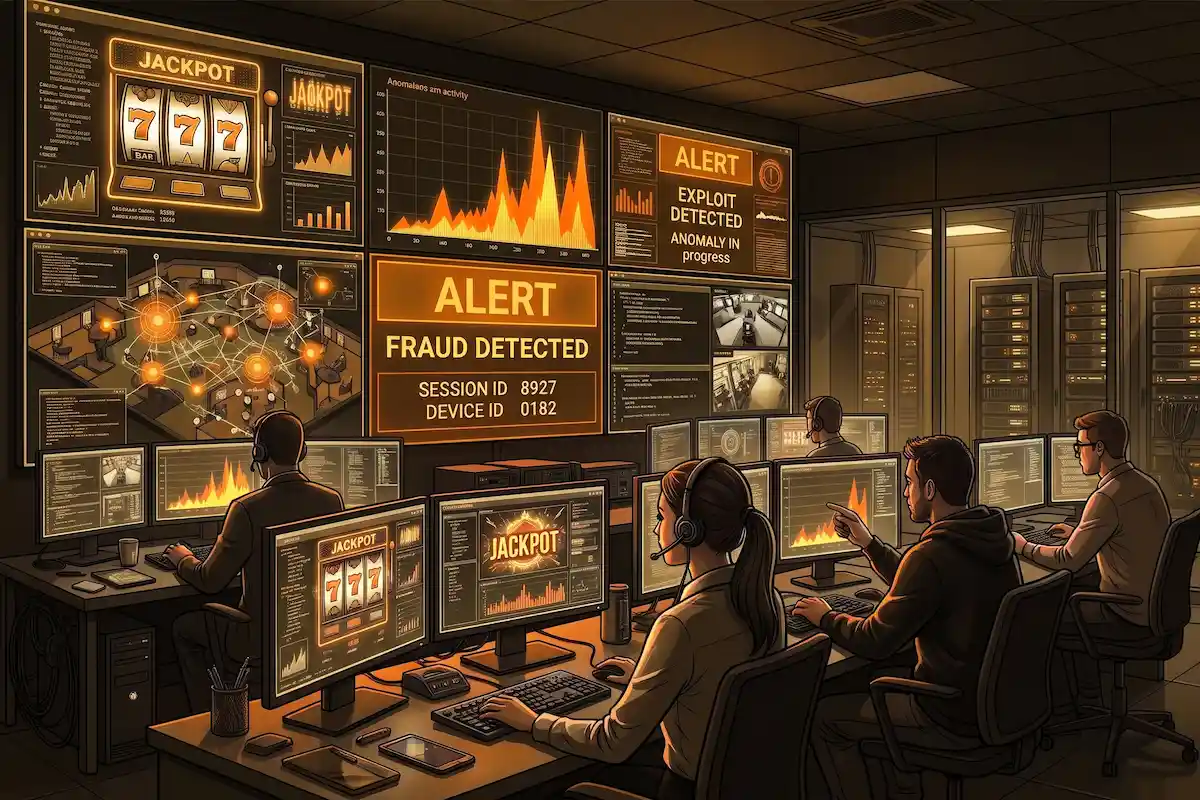
    Initial signs of problems are easy to spot. If a game suddenly starts being played a lot more than it used to without specific promotion, such as placing it on the home page of the casino, that can be a sign of problems about to happen.

    If suddenly, the redemption requests spike abnormally, the financial fraud prevention teams need to open the back office and review game sessions.

    If many players start profiting from the same game out of the blue, chances are there’s a faulty game being exploited.

    There are communities dedicated to detecting these faults and exploiting them in cooperation, which can cause big liabilities if withdrawals are approved without understanding that something is off and the casino is basically being robbed.

    Moreover, understanding whether a player is interacting with several slots is important because that indicates a dilution of risk across different game types and potentially legitimate gameplay.

    An example of a Sweepstakes Slot Exploitation Smoking Gun

    A typical scenario of news spreading among players that a game is paying abnormally due to natural technical failures in the RNGs or an actual hacking attack will involve factors like:

    • A new player registers and deposits large amounts of money;
    • The new player obtains the redeemable coin as fast as possible;
    • Sequential bets are placed on a single slot;
    • The slot is paying a high percentage of winning rounds.

    Factors that can contribute to fast risk mitigation include teams that are proficient in the world of gaming.

    A great financial fraud prevention manager with strong contacts in the financial industry and deep knowledge of PSPs is not a complete leader if he or she doesn’t know the basics about the operator’s or platform’s game portfolio.

    As mentioned, a faulty in-house game is a very different problem than one provided by a market-leading supplier.

    If a faulty game is spotted and technical teams lose time trying to understand basic questions such as:

    • What is the game’s GSP;
    • How to disable a game;
    • How to contact the GSP (ticket, Slack, or other form of contact);
    • Who’s in charge of emergency situations and choices of game replacement;

    Chances are, more time than necessary will pass, and the liabilities derived from the faulty game can grow exponentially.

    A good operator must be a well-oiled machine with near-polymath team members who blend technical expertise, financial literacy, and industry game content knowledge. 

    Of course, each team member has key responsibilities and knowledge, but learning the basics of the other areas is crucial to prevent disastrous scenarios when your shop is live 24/7, like an online sweepstakes casino. 

  • When Players Try to Exploit AMOE Credits: Understanding Patterns

    When Players Try to Exploit AMOE Credits: Understanding Patterns

    Unlike real-money casinos, sweepstakes casinos face different interactions with players. A sweepstakes player tries to exploit AMOE and profit in different ways compared to a player trying to maximize their chances by making the most of traditional bonus offers.

    If a particular player feels like a bonus offer is good, for example, at a UK online casino, let’s say the usual package system of tiered bonuses, where sequential deposits release progressive bonus funds, the player’s strategy to use those bonuses will be much different compared to a sweepstakes casino.

    Rollover rules at a real-money casino do not apply in the same way. Traditional bonus offers usually come with rollover rules that aim to prevent an easy withdrawal of the bonus funds instead of actual gambling action.

    How a Sweepstakes Casino Player Tries to Profit From AMOE by Managing Risk

    When a sweepstakes casino player starts a gaming session, they need to play to earn coins that are actually withdrawable. 

    To do that, they must bet the internal currency, which can’t be exchanged for money, to eventually earn coins that can be redeemed for cash.

    Names vary by operator, but they are usually called Fun Coin (FC) and Sweep Coin (SC).

    When trying to bet the coins that are not redeemable, the behavior and choices of games can be different compared to sessions with the coins that are redeemable.

    Of course, we are talking about players who strategize their sessions, and that includes players who actively seek free AMOE credits, including physical mail requests.

    Players trying to maximize session profits through strategic betting can be as problematic as card counting at a land-based casino table.

    The exact patterns a player uses, and how they relate to casino terms and conditions, vary from operator to operator.

    The worst problem, however, is when a sweepstakes casino isn’t prepared for interactions with members of communities that strategize AMOE credit requests and how they use the credits received.

    Real-money decision-makers must be very attentive to this reality in America.

    AMOE isn’t just a great idea to operate in the gray area; it represents an actual potential financial liability and a big potential source of margin corrosion, in a market that faces big risk and potential regulatory changes at any time.

    Smart AMOE credit concessions and clear tracking of player sessions are vital to break even and profit sustainably within the U.S. Sweepstakes environment.

  • Sweepstakes Coin Purchases VS Gambling Credit Card Transactions

    Sweepstakes Coin Purchases VS Gambling Credit Card Transactions

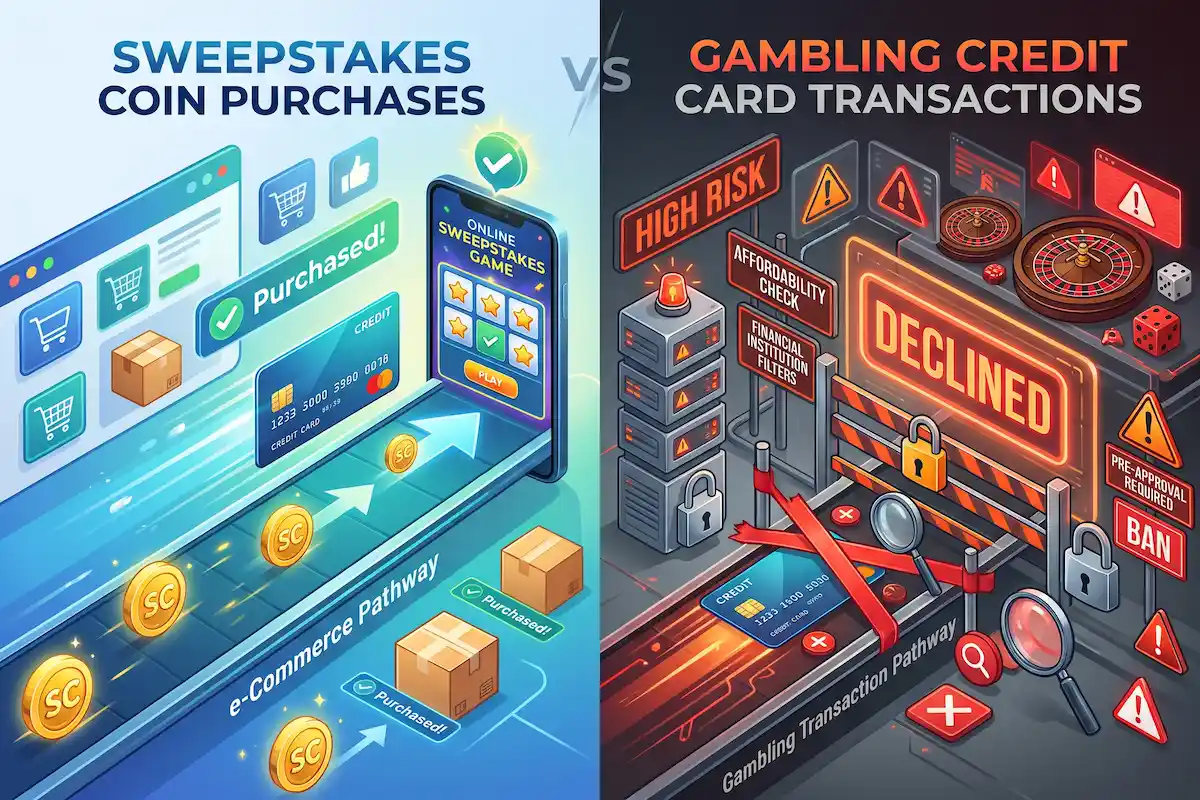
    The American sweepstakes casino environment has an operational advantage: financial transactions are often processed as e-commerce transactions instead of gambling.

    Gambling transactions bring an entirely different set of security risks and filters. A charge, no matter how small, on a credit or debit card to deposit money to bet online, triggers an entirely different “journey” for that transaction.

    Some financial institutions ban gambling-related transactions right away. 

    Other institutions require pre-approval; that is, the customer contacts the bank’s CS to say that such a transaction might happen.

    Also, gambling-related expenses might be subject to affordability checks depending on the regulations of each jurisdiction, whether in America or internationally. Even if clear affordability checks aren’t a reality in a gray area market, that is a good example of why gambling expenses and PSP operations are technically called “high risk markets”.

    Also, gambling markets are considered high risk because it is easy to convert a gambling deposit into real cash with low-risk bets, for example, entering and leaving a crash game, for example, or in other low-risk games like low-volatility slots, to meet minimum rollover requirements when necessary.

    Sweepstakes are no exception, because some transactions are eventually flagged as gaming. Banks and credit card companies have their own security standards, even though sweepstakes casinos aren’t technically considered casinos that require a license. 

    Sweepstakes Casino Credit Card Charges: Potentially as Easy as an e-commerce transaction

    Sweepstakes Casinos usually benefit from e-commerce payment pathways when charging credit cards, which might sound completely insane to a real-money iGaming executive in Europe new to the sweepstakes environment.

    The fact that some, but not all, transactions are flagged this way explains why financial teams trying to understand why some transactions are denied and some aren’t in America find it so complex. 

    I personally helped anti-fraud teams during night shifts operating in America, as part of my multi-role executive work within platforms and operators, and I learned firsthand that every situation is a different case, depending on factors such as the bank issuing the card, the state, and other factors like the digital financial filters of each PSP, the hour of the day, the amount of the transaction, and repeated transactions of the same amount within minutes, for example, among several other potential factors.