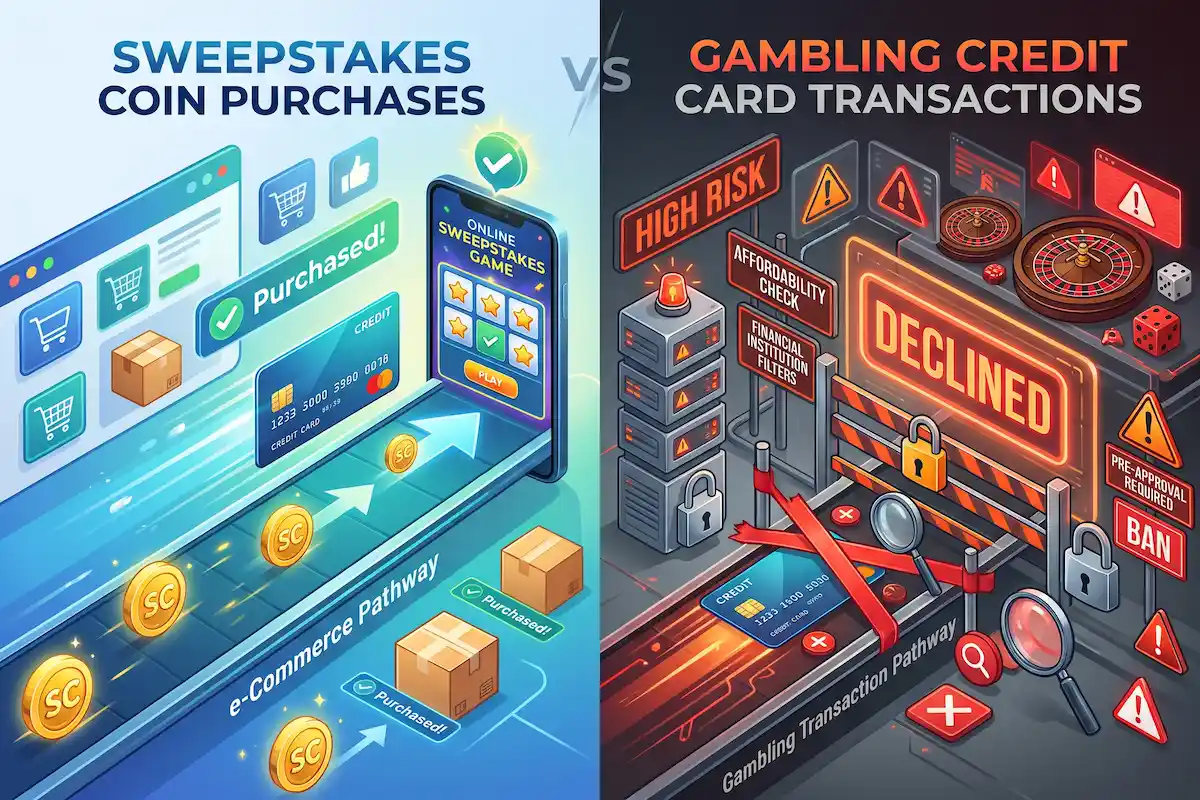
The American sweepstakes casino environment has an operational advantage: financial transactions are often processed as e-commerce transactions instead of gambling.
Gambling transactions bring an entirely different set of security risks and filters. A charge, no matter how small, on a credit or debit card to deposit money to bet online, triggers an entirely different “journey” for that transaction.
Some financial institutions ban gambling-related transactions right away.
Other institutions require pre-approval; that is, the customer contacts the bank’s CS to say that such a transaction might happen.
Also, gambling-related expenses might be subject to affordability checks depending on the regulations of each jurisdiction, whether in America or internationally. Even if clear affordability checks aren’t a reality in a gray area market, that is a good example of why gambling expenses and PSP operations are technically called “high risk markets”.
Also, gambling markets are considered high risk because it is easy to convert a gambling deposit into real cash with low-risk bets, for example, entering and leaving a crash game, for example, or in other low-risk games like low-volatility slots, to meet minimum rollover requirements when necessary.
Sweepstakes are no exception, because some transactions are eventually flagged as gaming. Banks and credit card companies have their own security standards, even though sweepstakes casinos aren’t technically considered casinos that require a license.
Sweepstakes Casino Credit Card Charges: Potentially as Easy as an e-commerce transaction
Sweepstakes Casinos usually benefit from e-commerce payment pathways when charging credit cards, which might sound completely insane to a real-money iGaming executive in Europe new to the sweepstakes environment.
The fact that some, but not all, transactions are flagged this way explains why financial teams trying to understand why some transactions are denied and some aren’t in America find it so complex.
I personally helped anti-fraud teams during night shifts operating in America, as part of my multi-role executive work within platforms and operators, and I learned firsthand that every situation is a different case, depending on factors such as the bank issuing the card, the state, and other factors like the digital financial filters of each PSP, the hour of the day, the amount of the transaction, and repeated transactions of the same amount within minutes, for example, among several other potential factors.
Leave a Reply