Sweepstakes VS Real Money Invoicing: GSP <> Operators
This article is especially relevant for real-money execs who have never worked in the sweepstakes vertical.
In the sweeps market, invoicing an operator or a platform working on behalf of one comes with an added layer of complexity.
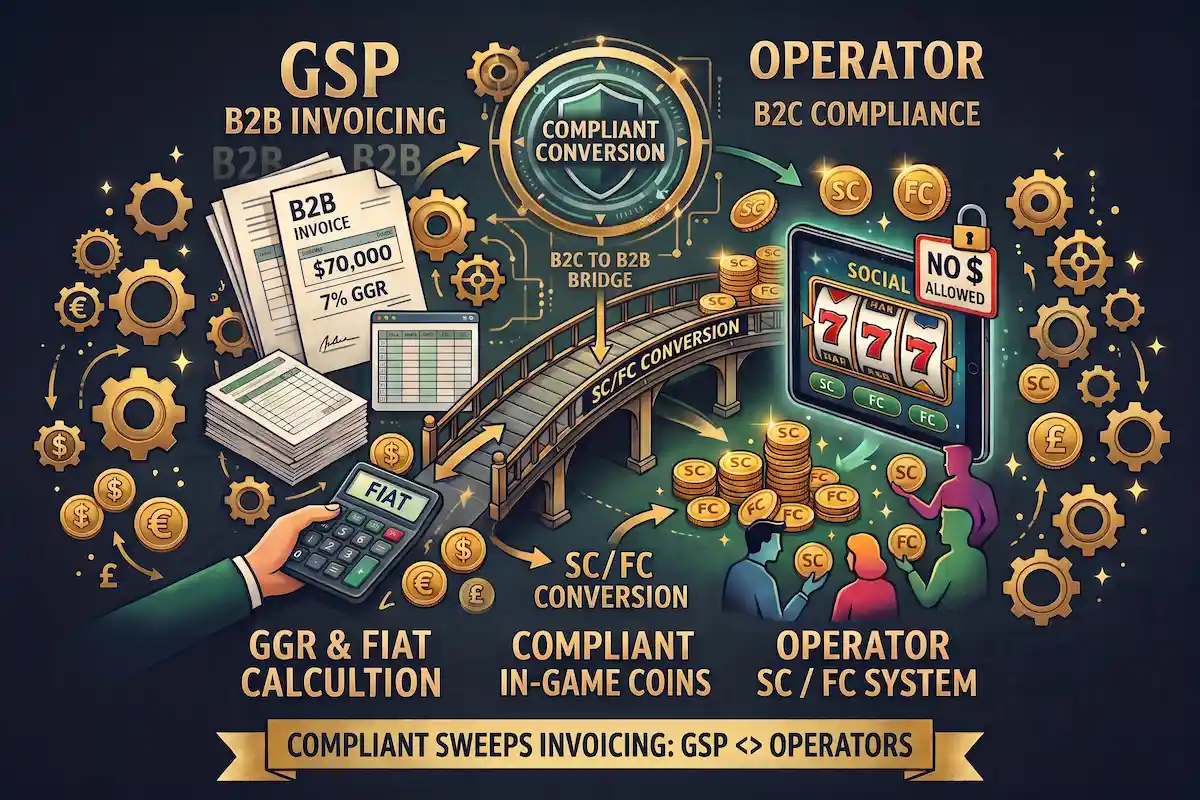
In a normal market operating online, let’s say that any given GSP has an active contract charging 7% GGR as a standard price. Now suppose a GGR of $1MM in a month; that would generate an invoice of $70k.
But customers of sweepstakes casinos can’t see any reference to real money within games.
Hence the SC and FC system. Social Coin and Fun Coin are extremely relevant to preserve compliance and allow the operators to work within what’s stipulated in the legal opinions that back the business.
How Sweep Coins and Fun Coins Affect Invoicing
Essentially, operators and platforms must set an internal value for the coin in financial terms. GSPs will then charge fiat currency based on the commissions generated for the use of proprietary IP.
So a typical GSP invoice will bring a conversion rate of the determined financial value for the use of the IP, pegged to the currencies visible to the users.
This way, everyone remains compliant with the regulations, and B2C-facing products like slots only mention what is legally allowed.
Dollars, Euros and Pounds: B2B Environment Only
References to fiat currency must always be checked. Exposing customers to fiat mentions, if proven by the authorities, can generate substantial fines and legal liabilities.
Operating Under Legal Opinion at Grey Markets VS Licensed White Markets
Teams operating under LO and aiming to serve customers legally within grey markets must work in a vigilant manner at all times.
Team cooperation is essential, and one of the most important things that I learned in my time at sweepstakes platforms is how all team members, regardless of their role, must learn about the internal dictionary of terms allowed and not allowed.
We’ll explore the concept of a Sweepstakes-Compliant Dictionary in an upcoming article.
If a team member spots a $, €, or £ symbol on an operator website, a red alert must sound, and the team must focus on suppressing non-compliant data, whether in the form of communications, products, or other violations, securing the legal safety of the operator client and the platform itself.
First, fix the problem, and investigate the origin of the failure later. Trying to find culprits and pointing fingers before fixing a visible problem is a terrible policy, and leaders in the sweepstakes space must frequently reinforce the protocols if compliance issues are spotted.
Compliance is incredibly important in the sweepstakes market, even if somewhat counterintuitive to some: the fact that there isn’t a traditional gaming license doesn’t mean an absence of rules; on the contrary, the vigilance required to operate safely, relying on the intricacies of legal opinions, is often more complex, and certainly different from operating in fully unregulated markets or within clearly regulated white markets.
Leave a Reply