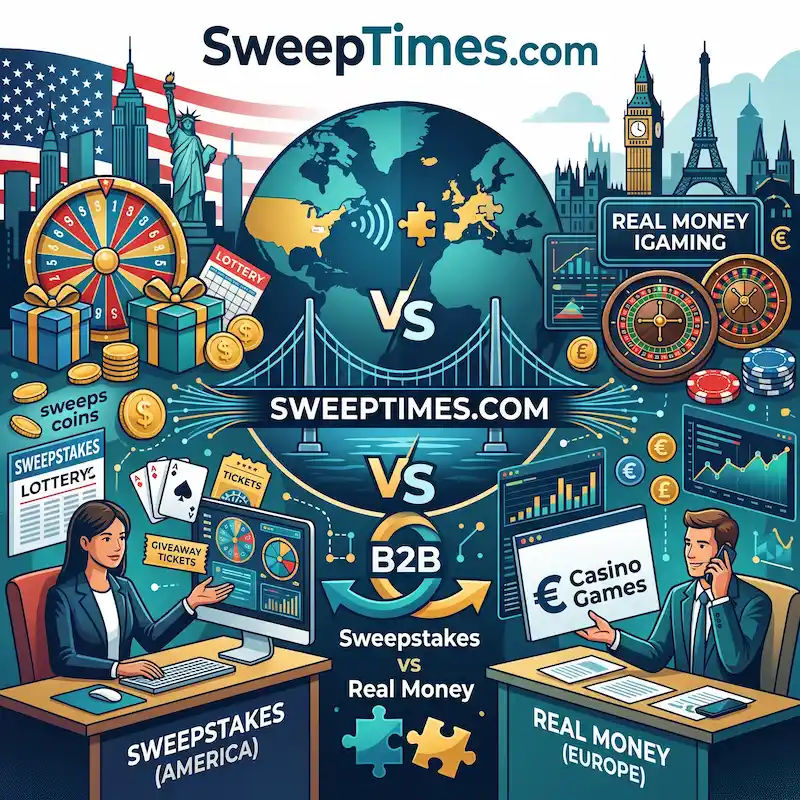
U.S. sweepstakes casinos operate in a gray market because they offer real-money prize redemptions or equivalent (like gift cards) without obtaining state gaming licenses. Instead of following traditional gambling regulations, they rely on standard consumer sweepstakes laws using a dual-currency, ‘no purchase necessary’ model to operate legally in states that have not explicitly banned them.
The gaming industry has always been divided into three very clear markets:
- regulated (white) markets, that is, jurisdictions like American states or countries that issue gaming licenses, or even cities in cases like Buenos Aires.
- Black market operations: criminal enterprises that operate where local laws explicitly do not allow gaming operations of a specific vertical.
- Gray markets: cloudy points within legislation that allow specific products or services under very specific conditions. In America, operators usually work under the legal opinion concept.
Understanding What Is a Legal Opinion in America
Essentially, a Legal Opinion is a legal interpretation issued by a law firm. This document contains the reasoning explaining why this specific lawyer or law firm believes that the product in question is viable within the law of a specific state.
These documents are credible because a lawyer can be disbarred for blatantly selling a legal document that defends illegal activity.
Therefore, while a legal opinion is understood to be Intelectual Property of the client that acquires it, in the sense that understanding the intricacies of law to the point of commercially profiting from an elegant and unusual understanding of that, Legal Opinions might need to be defended in court.
If a state or even federal Attorney General, or a competitor, sues a sweepstakes operator, the law firm or lawyer who signs it must explain their reasoning before a judge, risking their professional license if clear wrongdoing is found.
Legal opinions usually work around the legal concept of “more likely than not”, which in American law refers to a probability of over 50% of the understanding being correct.
Of course, translating semantic concepts into probability surely is subjective in some ways, but the concept of more likely than not differs from others like “beyond reasonable doubt”, which is used in criminal law and refers to an understanding that something is 95% likely to be true.
Understanding Gray Gaming Markets: Not Just For The Legal Teams
It is understandable that some execs might feel like the intricacies of gaming law affect solely the CLO or the law firms hired by operators, suppliers, and platforms.
But that is absolutely not the reality. The intricacies of legal opinions unfold as many technical tasks within operators and platforms.
I’ve seen firsthand the impact that constantly reviewing whether an operator remains compliant has on everyone in customer-facing content.
I recall several situations where problems were flagged on Fridays, which is a disaster for gaming operations.
Usually, an operator, whether sweepstakes or real-money gaming, is prepared for the weekends as there’s a peak in visitors, and that includes commercial agreements with GSPs, new layouts, not to mention festive dates like Halloween, Christmas, New Year’s Eve, Easter, and other holidays.
I recall one specific situation where a European GSP malfunctioned. The game was natively coded to display Euros, and due to a malfunction, an € sign ended up in the front end of a slot, visible to American customers of a sweepstakes casino.
The game had to be disabled, a ticket had to be opened with the GSP, and the game was unavailable for the coming days. Moreover, because the game was on the casino’s home page, I also had to review all commercial agreements between the GSP and the operator to select the best game for our operator client.
None of these details appear in a Legal Opinion, but the core issue was simple: no mention of actual fiat currency can ever be visible in an American Sweepstakes casino. All references must be changed to alternate coins like SC and FC.
Sometimes, teams get agitated when problems like this happen, and team leaders need to stress the legal importance of complying with every small technical detail to avoid legal liabilities in America, which is far more prone to litigation than Europe.
Not only are the legal requirements of the operations not confined to legal teams, but sometimes we also have to explain what the cultural differences across jurisdictions are; that is, why it is more dangerous to remain 24 hours with non-compliant content online in a place like the U.S. compared to many other countries in the world.